
Background on the Zero Carbon challenge
Romsey Abbey is a Grade 1 listed building in a largely Romanesque style with origins stretching back over 1,000 years. As such, it is a large space with no insulation and is heated with gas-fired boilers that are over 40 years old.
Despite its age, it remains a vibrant centre of Romsey life (pop.c.20,000) for worship, cultural and civic events. It is recognised by the Church of England as one of only 300 English Major Churches which are physically large and of "exceptional architectural and/or historical significance".
Increases in greenhouse gases in the atmosphere are changing our climate, raising temperatures (they have risen by almost 1.5 degrees celcius since the 1880s) and changing rainfall patterns. Carbon dioxide is a major factor and the Abbey is working to reduce its contribution.
Since 2017, the Abbey has had a group of volunteers foussed on reducing the Abbey's environmental impact and on bringing environmental issues to the attention of the congregation. The group's activities were given greater impetus in 2020 when the Church of England General Synod voted for the whole Church of England to achieve net zero carbon by 2030. This vote recognised that the global climate emergency is a crisis for God's creation and unjust to the poor and future generations. This was further reinforced by the (2021 - 2023) report from the United Nations Inter-governmental Panel for Climate Change (IPCC) which contained the following words:
"Some future (climate) changes are unavoidable and/or irreversible but can be limited by deep. rapid and sustained global greenhouse gas emissions reduction." (IPCC Synthesis Report 2023 Summary for Policy Makers section B3)
How the atmosphere has changed in the last 1,000 years or so
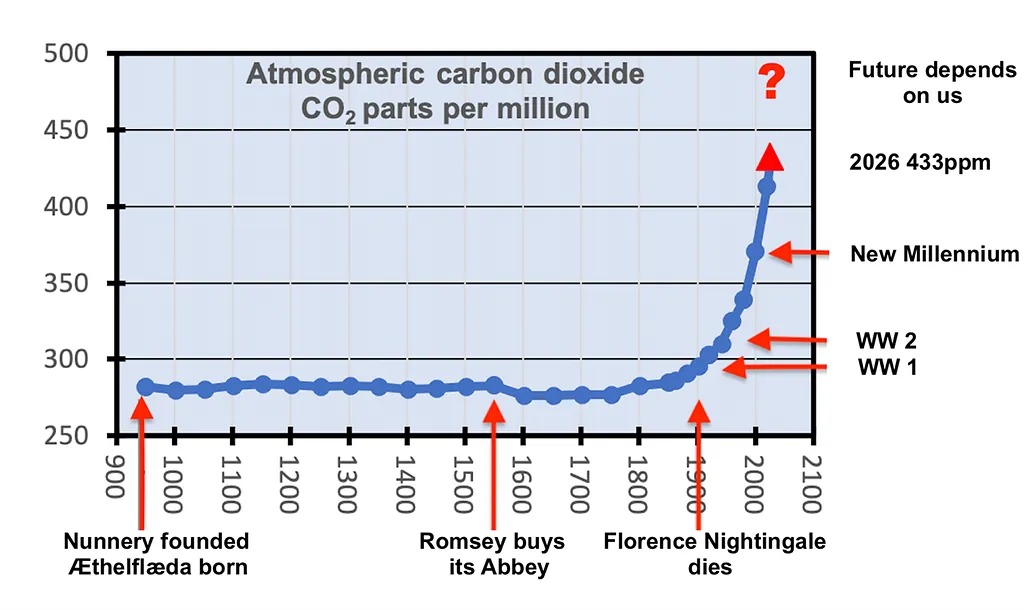
CO2 levels are now the highest they have been in the last 14m years. Most of the change has been in our lifetimes.
WE CAUSED THE PROBLEM - IT IS OUR RESPONSIBILITY TO FIX IT
We had better do it soon - every little helps!